Wimbledon’s move to Milton Keynes remains one of the most unpopular decisions to have been made in the history of English football, with the club widely derided for taking the team away from their South West London roots. The reality is that the club had already become nomadic wanderers around South London and didn’t have a place to call their own.
As with all arguments, there are two sides to this story. Wimbledon fans and much of the wider football community were appalled that The Dons were to be become what is often described as a franchise club. I know distances are not quite so great, but another club from south of the river decided to move its home further north back in 1913 and nobody refers to Arsenal as a franchise club! To quote from Arsenal’s own website, their move from Woolwich “was borne of ambition and necessity. Without it, the Club may not even have survived”. As with Arsenal’s move, Wimbledon’s owners felt they needed a new home ground to ensure the survival of their club.
Whichever side of the fence you sit, MK Dons continue to exist and they remain as ambitious as they ever were. For the romantics and the original fans unwilling to move, AFC Wimbledon have taken the place in their hearts that was previously reserved for the Crazy Gang.
The town of Milton Keynes was created almost from scratch, with many of its early residents and businesses relocating from London, making this “new town” an apt choice for the home of this virtually new club. The town had long wanted to build a major stadium, but didn’t have a team. With none of the more local clubs wanting a move and Wimbledon struggling financially, a deal was eventually struck. After a few years at the National Hockey Stadium, MK Dons eventually moved to their new ground in 2007.
If you were to watch a match at Stadium mk on TV, you’d be forgiven for thinking this is just another identikit new stadium. But, there is far more to this venue than first meets the eye. In the best traditions of all things MK, it is part of a purpose-built new development; with the site incorporating huge superstores, a retail park, high street eateries and a cinema. Situated away from the town’s railway stations, there is plenty of parking, which is supplemented by shuttle buses connecting Milton Keynes Central station on a match day. That said, traffic is a challenge that needs to be addressed for the, to date, rare occasions when the stadium has been close to capacity. Preparations for Rugby World Cup matches should help ensure that the club and the town are both ready for the increase in attendances that will come following promotion to the Championship.
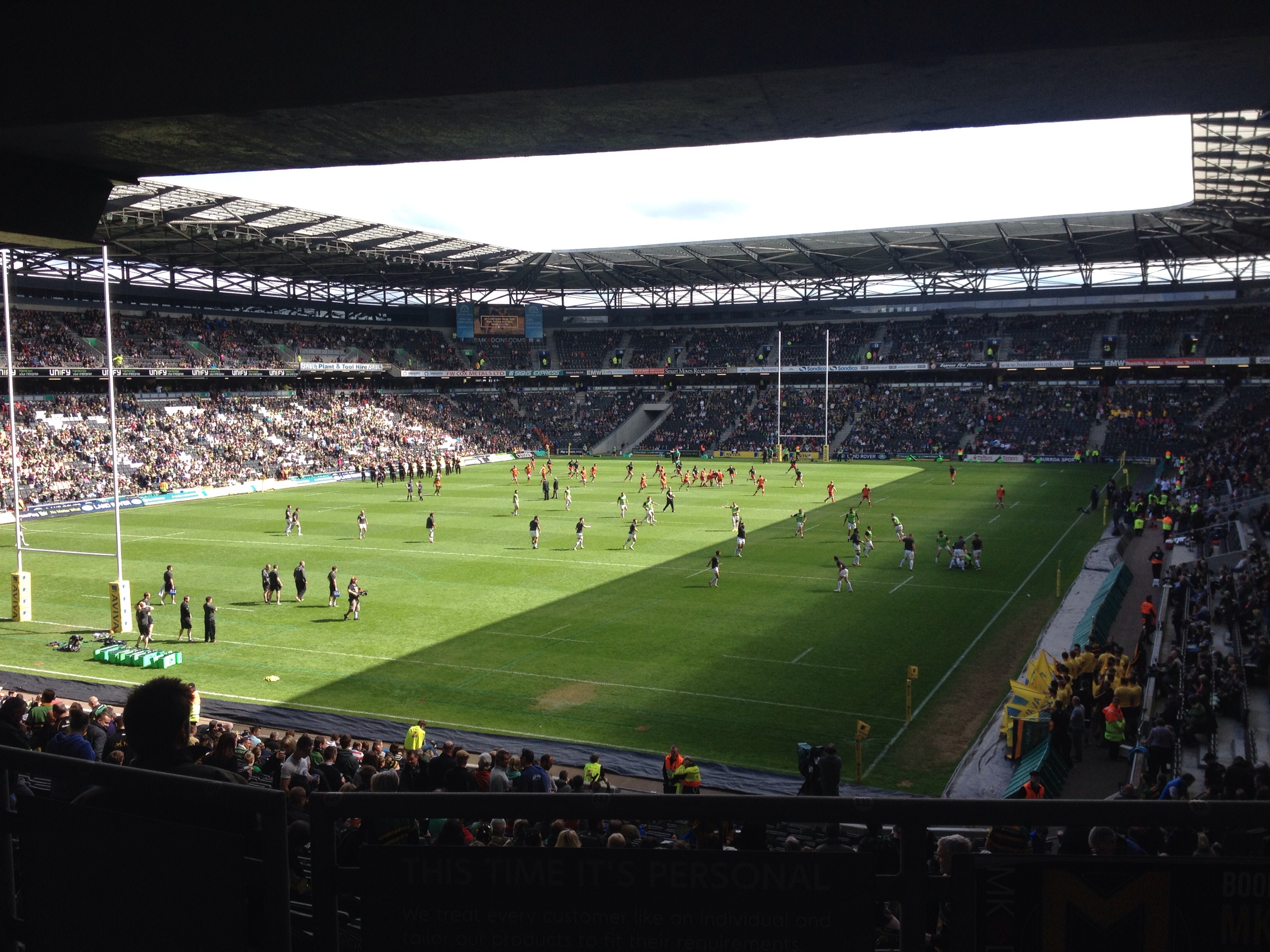
I’ve found myself working at two events at Stadium mk in the past few weeks and I’ve become a huge fan of the external look and its practicality in terms of design and function. It is a blueprint for clever simplicity. The black seating forms an enclosed bowl, with most spectators entering directly at the concourse level which forms a continuous loop at the top of the lower tier, offering uninterupted views of the playing surface. Whilst there are private corridors for use by stadium staff and the club, the way the building flows in these continuous loops, akin to the roundabouts MK is famous for, makes getting lost an almost impossible task.
Maximising use of the venue throughout the year is achieved in two ways. Firstly through the hotel (and its conferencing facilities) that is seamlessly incorporated into the building, so much so that the event control room is accessed via a private door in a hotel corridor. Having first walked these corridors looking for my room and studying the myriad of stunning photos adorning the walls that chart the development of the stadium, I’d not realised the level of integration that existed as I walked past the control room completely oblivious to its presence; in fact, when I needed to find it for operational reasons at an event the next day, I struggled! The second is another fully integrated appendage providing a 3,420 sqm arena space, suitable for exhibitions; indoor sports and concerts with a 4,600 capacity; or simply an area in which to extend the match day food and beverage provision and offer some respite from the elements.
The decision to build the stadium in stages highlights further this clever simplicity. The lower tier of seating, along with hotel rooms in the west stand, was completed first, enabling the club to move in with a more than ample seating capacity for a growing club mostly plying its trade in League One. The upper tier remained as barren concrete terraces for many years before seats were recently added to take the capacity from 22,000 to 30,700. The upper tier, accessible from the main concourse, can be closed off entirely and only opened for the busiest days. In addition to the extra seating, more hotel rooms have been added above the seating bowl, giving the impression of a completed project. However, the expansion may not stop there, with plans currently mothballed for a further tier of seating to be added that could push capacity towards 45,000. Whilst that is a long way from the typical 9,000 football attendance, the club are well positioned to continue their growth. The stadium itself is ready, willing and able to host other events, with the Rugby World Cup coming this autumn and Northampton Saints close enough to become temporary tenants for their biggest matches. In addition to the growth of The Dons, Stadium mk was part of the failed England 2018 World Cup bid and I’m sure would push its way into contention once Blatter finally departs and the FA feel ready for another dart at hosting a major tournament. In the shorter term, Spurs could yet make use of this gem of a stadium whilst their own new build is under construction. I’d be more than happy to make the trek north to see it full on a regular basis. Although by the time that happens MK Dons could already be an established Premier League team.
Stadium mk is also a model of economic pragmatism, with each phase having been funded through the sale of the surrounding retail space. This has brought people and a vibrancy to the area that ensures the stadium does not feel as if it is stuck out in the middle of nowhere.
Whatever you may think of the ‘franchise’ club that calls Stadium mk home, it’s hard to deny that this venue provides a model for others to follow, successfully balancing practicality, looks, costs and future-proofing.
 StadiaGaga
It’s about 15 mins walk from Bletchely railway station with 2 pubs and an assortment of fast food on the way 😉
LikeLike
Bletchley railway station certainly is walkable, but you must walk much quicker than me (or know a good shortcut) 😉
LikeLike
There are indeed two sides to every story and let’s not forget that the stadium you’re praising is basically built on the corpse of Wimbledon FC. Just because we’ve rebuilt our own club for Wimbledon does not excuse all those that destroyed Wimbledon FC (including Pete Winkelman, who instigated the move), using it to facilitate the property deal that gave Milton Keynes an Asda, a stadium and Wimbledon’s Football League place. By all means praise the stadium for what it is now, but remember to count the cost to Wimbledon fans and remember that we have never received any compensation nor even an apology, and have done everything ourselves to recreate what was stolen from us. Until those supporting Franchise FC choose to properly acknowledge these things, I see no reason for anyone to forget or even forgive what was done, no matter how much you like the stadium.
LikeLike