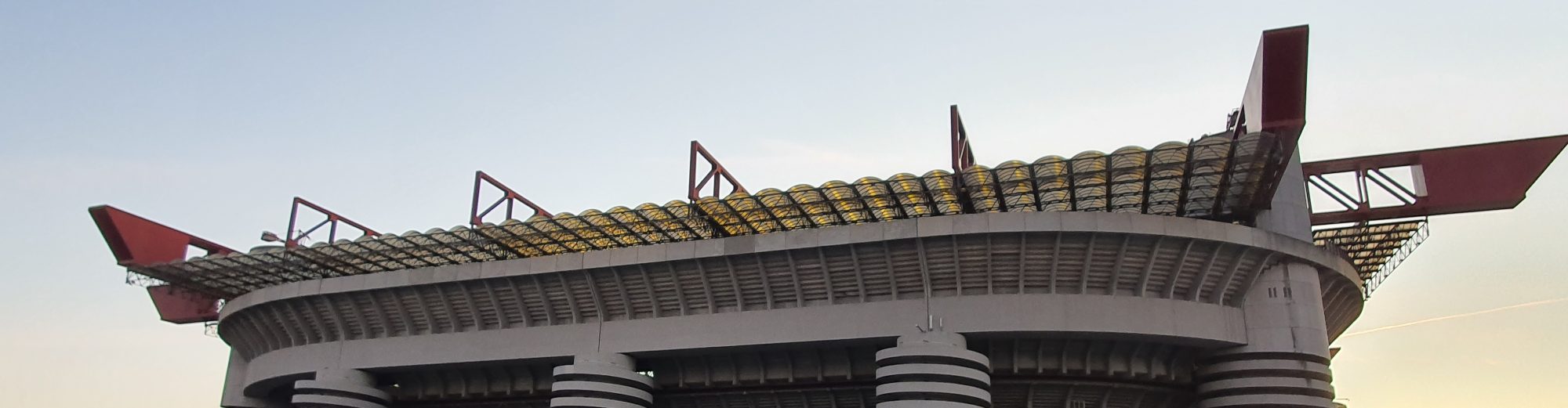
Despite England’s early exit and the disappointment of the northern hemisphere teams all departing before the semi-finals, Rugby World Cup 2015 closed with an abundance of great memories and a declaration from World Rugby that the tournament had been the “biggest and best”. It seems fitting to reignite my blog writing with a reflection on the tournament and its venues, and in particular the challenges of transitioning stadia for use in a major tournament, especially when the sport involved may be alien to that venue.
One of the toughest choices at the outset was where to play the matches; not only to maximise the opportunities for fans to purchase tickets but also recognising that this tournament is rugby’s main stage from which to pitch to the world. Whilst this country now has enough large modern stadia to host these global events without the need for vast construction programmes, the focus is firmly on football. The organisers wanted to utilise rugby venues and in choosing Sandy Park and Kingsholm, they ensured some of this country’s most fervent rugby fans got the chance to see the tournament in their more compact backyards. With the colossuses of Millennium Stadium and Twickenham added into the mix, the use of four dedicated rugby venues was probably a fair balance; although Leicester may not agree.
The use of King Power Stadium, or ‘Leicester City Stadium’ for the purposes of the tournament, over Leicester Tigers’ ground was probably the hardest decision of all. Welford Road has undergone significant developments to make it the largest dedicated club rugby venue in England, yet the facilities were not deemed suitable and the pitch too narrow for a world cup. Despite the protestations and scare-mongering about low attendances, over 27,000 were treated to a record-breaking comeback by Romania and even larger crowds witnessed two visits by the hugely entertaining and successful Pumas. Having watched Romania’s famous win first-hand, I was amazed by the atmosphere generated for what might have been mistaken for a dead-rubber. The Romanian fans I sat with didn’t see it that way as they chanted and cheered their team as they clawed their way back into the contest and on to victory. And, for the record, it didn’t look as though they felt they were missing out by not playing in a ‘rugby’ stadium. 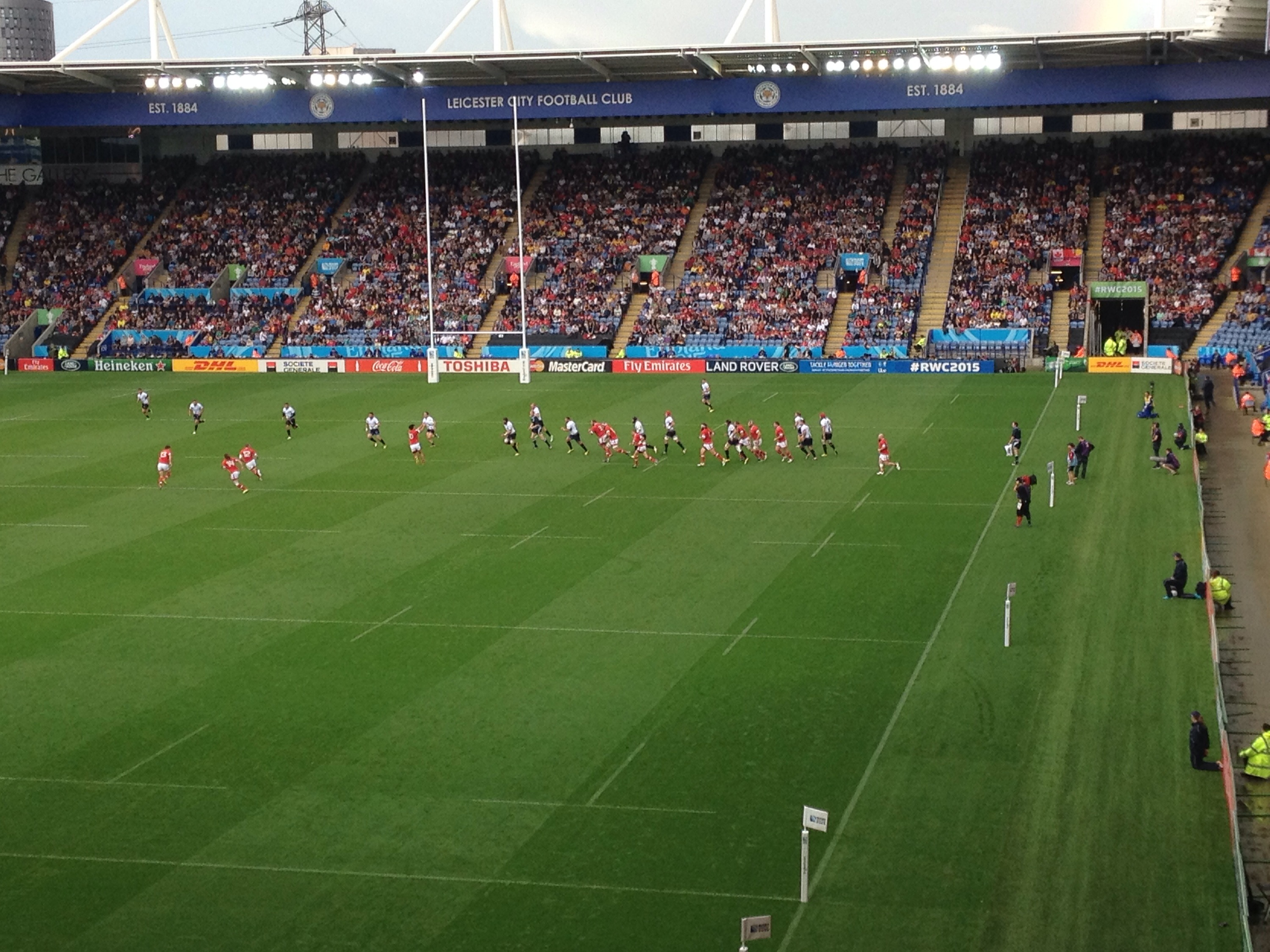 ‘Leicester City Stadium’
I managed to visit seven venues during the tournament, and I have also been fortunate enough to have seen all 13 in the flesh over the past couple of years, giving me a privileged insight into the challenges of setting these stadia up for the Rugby World Cup bandwagon to roll into town, or 11 cities in this instance.
Whilst every venue needed some transitional work to make it tournament-ready, the football-specific venues only had to cater for three fundamental adjustments: new post sockets; added protection for players sliding from the field of play; and alcohol. The last of these needs a major mindset shift in the stewarding teams who otherwise police the vomitories to make sure that any alcohol served on venue remains firmly out of sight of the seating bowl. The other issue that alcohol highlights in football stadia seems to be the tightness of the seating configuration. I’m not sure if it is just an illusion, but the intimate layout is certainly not conducive to carrying four pints to your seat.
What is universal is the need for venues, no matter how modern and built to be future-proof, to make adjustments to their configuration and tried and tested operating models. A feature of major events is that the governing bodies are always demanding more. From larger perimeter advertising boards, to additional press tribune seats, every venue needs at least a few tweaks.
The simplest and most dramatic adjustments come from the overlaying of branding for a major event. Rugby World Cup’s partner in providing the right look across its venues, Icon, managed to take the branding guidelines to create a bright new look and feel to even the tired, ageing and most basic of stadia. Part of this overlay is also to clean stadia of existing and often conflicting branding. The addition of coloured panels and decals in the quantity used had such an effect on so many venues, I will be interested to see if any of these low-cost ideas give owners enough food for thought to want continue to dress their buildings in this season’s trends that are uniquely wearable for all shapes and sizes.
It is probably not surprising that Sandy Park and Kingsholm needed additional temporary buildings to supplement the space available to the media and workforce, since these venues are not used to the influx of people required to put on an event of this scale. And whilst many venues were able to repurpose space for the duration of the time England 2015 were in town, you might be amazed to discover that demand for extra facilities in Cardiff and Twickenham, and even the super-sized Wembley, were such that these mini-cities still needed to procure additional space to enable every client group to operate effectively.
Stadium architects can only plan for what is known, expected and required of them in their designs, and with the largest events billed as once-in-a-lifetime experiences, there is little wonder as to why Leicester Tigers have chosen not to make their development plans with the occasional global tournament in mind. Their prime objective, quite rightly, is to ensure that they have the best possible stage for their team to perform at the highest attainable level. Whether anybody will ever build a venue that can be all things to all people is debatable. Wembley is as close as we get at present, and though it has scope to transform for athletics, even it may struggle to host international cricket. There may be one place in the UK that could rival it over the coming years, and that from a stadium that was originally built with a different future in mind to the one which is evolving.
The most significant conversion required for the visit of rugby’s giants was reserved for the Olympic Stadium, or the mouthful that is ‘The Stadium, Queen Elizabeth Olympic Park’ (QEOP), to give it its official title. As an aside, to call your venue The Stadium works perfectly whilst you are in the pleasant confines of QEOP, but it is going to confuse a hell of a lot of tourists and occasional visitors looking for the playground of Jess, Mo, Usain and friends. Try searching ‘The Stadium, London’ into Google Maps – it’s not that obvious! I’m sure this name will evolve again once West Ham move in.
I’ve written in the past about this stadium and the Hammers’ fortune at being virtually gifted a brand new venue and a gilt-edged opportunity to move themselves on to a higher plane, but it was always with a doubt as to how successful the transition of this venue might be, even after moving the lower tier of seating closer to the pitch.
I’d expectantly hoped for some kind of mechanical solution that would see the lower sections of the seating bowl seamlessly glide across the athletics track into position for ball sports and back again for track and field (and hopefully cricket), much as is in place at the Stade de France in Paris. At first glance on TV, the illusion is of a perfect transformation; looking across from the main camera positions and the broadcast studio, you are presented with the appearance of one continuous tier of seating neatly joining the upper and lower sections, whilst hiding the spectator concourse from view in the process. However, this is only on the eastern side of the stadium. The other three sides do not allow anything so tidy; in fact, there are yawning chasms created between the main concourse and the lower tier, with the expanse spanned by a series of bridges. Whilst these voids look bizarre, there is little else that could have been done, such is the design of the upper tiers and the presence of the gigantic video boards at either end. The surprise element comes from discovering just how straightforward the lower tier solution is. The structures may appear temporary but, once the bridges and the upper sections of the eastern extension have been removed for storage, the rear supports simply fold away allowing the stepped seating to retract to rest above the old concrete stands so that athletics can return each summer. Despite my disappointment at the slightly jumbled final layout and all my reservations about the transition from the home of Olympians, the stadium’s eye-catching new roof adds a wow-factor all of its own. Not only will spectators stay dry, but the atmosphere generated, and enhanced by the stomping of feet on the suspended flooring of the lower bowl, will struggle to escape.
As unorthodox as elements of ‘The Stadium’ may be, the combined effect, even in spite of the distance of the upper levels from the pitch, somewhat surprisingly works. It is far from perfect, but the five successful Rugby World Cup matches this autumn have played a massive role in proving to West Ham that they have a golden opportunity to thrive as a tenant in what is effectively the most costly council house ever constructed. Sure, as a fan of a rival team, I am a little bitter, but then competition is meant to be a good thing. With my pragmatic stadium fan’s hat on, I’m more than happy to have had my concerns disproven and for this most versatile and now historic of venues to have such a bright future.  ‘The Stadium’ – lower tier contrasts
With World Rugby moving its focus to Japan in 2019, our little corner of north-west Europe can proudly add the title of best host of arguably the third biggest sporting event to that for the top of the pile just three years ago. With an array of fantastic stadia and events expertise galore, all supported by an army of enthusiastic volunteers, England should be more than ready, willing and able to make it a one, two, three once FIFA sorts its act out.
 StadiaGaga