The future of sports and entertainment venues is something of a hot topic in stadium circles, and with my own football team’s stadium project having been given the green light this week, it seemed an opportune time for me to take a closer look at this debate. PanStadia and Arena Management magazine has just featured their project with renowned stadium experts Populous, which looked into the venues of the future, but I’ve also recently read an intriguing article by Jeff Beckman titled ‘The Future of Stadiums’. Beckman questions where stadium design may head in the future and whether there is a need for them at all. He referenced the ongoing competition amongst NFL cities to build ever-grander venues and the exorbitant costs of these venues, with price tags starting at $1bn (approximately £665m) and breaching the £1bn barrier ($1.5bn) in some cases.
These behemoths can be a jaw-dropping sight and are successfully pushing the boundaries of what is feasible in stadium design. The eye-catching circular retractable roof (similar to the opening of a camera lens) of the Mercedes-Benz stadium in Atlanta will be something entirely new in the world of stadium roofing when it opens in 2017.
There are two key things that distinguish these new NFL stadia from venues in the UK.
Firstly, there is a huge appetite to provide a plethora of facilities focussed on the spectators to help enhance their game day experience, as if the match itself cannot sate the crowd’s appetite. Having also written about the differences between NHL arenas in North America, this appears a consistent theme in the United States; whereas Canadian hockey fans want to be close to the action above all else. To us Brits, the focus is also on the sport and the main wish is for a reduction in queues for toilets and food and drink concessions so that we don’t miss any of the action on the pitch. Personally speaking, being able to use my mobile phone before a match and during breaks would be a nice-to-have, although there has even been a backlash to the provision of Wi-Fi at football grounds as the die-hards believe that you shouldn’t be there if you want to catch up on the latest scores from elsewhere or, heaven forbid, post an update to social media.
Secondly, the United States is blessed with significant amounts of space and has a far lower expectation for spectators to travel by public transport, whereas many larger football stadia on this side of the pond tend to find themselves with rather more limited space if they want to redevelop their existing home or build from scratch close by.
Additionally, the level of expense for club venues on the scale seen in the US is simply not an option for self-funded projects with little or no public finances available to help. Supporters wouldn’t accept the impact on their team’s finances, and finding the capital to fund such an expense would be impossible for all but the likes of Manchester City. Fortunately, and partly down to the lower expectations about the need for peripheral distractions, truly world-class venues with 60,000-plus capacities in the UK can still be realised for closer to £400m ($600m). Elsewhere in Europe, costs for even the largest stadia are often lower still.
Beckman’s article also puts the high costs stateside into starker context by highlighting the lifespan of some stadia alongside the relatively low number of events. With a number of venues being replaced or redeveloped every 20-30 years, costs per event can become astronomical. Such timescales are often no different in the UK: Chelsea are looking to rebuild their Stamford Bridge home, which was developed throughout the 1990s and finalised in 1998; White Hart Lane completed its latest development in 1998 (albeit that the main West Stand dates back to 1982); and West Ham’s newest stand opened as recently as 2001. I’d be surprised and disappointed to see these new structures replaced after just 20-30 years given that venues like Munich’s Allianz Arena (opened in 2005) and The Emirates (opened in 2006) retain an air of the ultra-modern. Sure, there will be some tweaks, but the genuine belief of clubs like Spurs is that these new stadia should become home to generations of fans to come. And the idea of one-upmanship is not exactly alien to England’s Premier League, with Spurs amending their original plan to take their proposed capacity from 56,250 to 61,080 – making it the largest club stadium in London and, most importantly, slightly larger than The Emirates! That said, I wouldn’t bet against Chelsea finding a way to squeeze in a few more seats to take that particular crown.
One of the main concepts in Beckman’s article was the idea of reducing this excessive cost and making better use of each stadium on a more regular basis. In European football, the key difference is the number of event days. The more successful teams can expect to play between 25 and 30 home matches each season. Using my favoured example, Spurs are expecting that there will be a further 16 events using the full stadium each year; providing far greater value than many NFL venues. Integration with the local area is another important factor to ensure that a stadium becomes either a 365-days-a-year attraction and/or has facilities in demand by the local community. Whilst many other new venues are broadening their use with conferencing facilities, Spurs are ensuring that their development encompasses the club’s requirement for a new venue, the financial reality of needing to encourage visitors throughout the year and the provision of new jobs and facilities for those living in an otherwise neglected corner of north London. A few miles to the south, the O2 Arena is a perfect illustration of a leisure and entertainment hub that is in regular use, even when there is no event in the main arena itself. Provided new stadia are not built too remotely, having a second life as a business, community, entertainment or leisure hub must be a consideration for all future stadium and arena builds.
The most drastic notion that Beckman suggested was the possibility of having no permanent stadium at all, or at least of having elements of temporary spectator stands to cope with peak demand. Personally, I am a fan of the idea of integrating venues as part of a multi-functional complex and leaving seating capacity expansion as an option. This is logical for one-off events or short tournaments, but not for a football team who sells out regularly. However, such is the development in the ‘pop-up’ venue sector; this could be a great option for smaller teams who may just want the flexibility to expand occasionally for the largest matches or for smaller grounds to be able to boost capacity to provide additional stadia when bidding for major tournaments and events. London 2012 took the lessons from previous Games, particularly Athens 2004, and managed to dodge white elephant syndrome by creating venues in iconic locations and allowing them to return to normal in the weeks that followed, much as is the case with Monaco’s F1 circuit and the Palio de Siena – a horse race that takes place in a medieval piazza.
I’ve mentioned previously that the ultimate goal for any stadium architect must be to create a truly multi-purpose venue that can transform itself for different sports and events. This Holy Grail is now becoming less of a dream, with real examples already in use or under construction. One of the most brilliantly conceived is the Saitama Super Arena in Japan: a 37,000 capacity indoor stadium capable of hosting American Football, with a 9,000 seat block that can move back and forth 70 metres to create a more intimate 22,000 seat arena and an exhibition space in the void that remains. It is a remarkable feat of design and engineering, but one that is unlikely to be replicated too often as full-sized field sports rarely need a roof. This level of flexibility is far better suited to arenas that want the ability to host a variety of traditional indoor events as intimately as possible. Returning, finally, to north London, the new White Hart Lane embraces the availability of these new powers of transformation in providing a sliding pitch. With a 10-year deal to host at least two NFL matches per season, the ability to protect the sacred turf is essential; after all, the stadium’s core raison d’être is as a home for a top-flight football team. In addition to the safeguarding of the surface, the team is also protected as the extra income from other events will help ensure that the new venue doesn’t become a burden and a ready-made excuse for reduced levels of performance on the pitch brought about by an inability to compete financially. Only the future will tell if this is the ideal blueprint for stadium development.
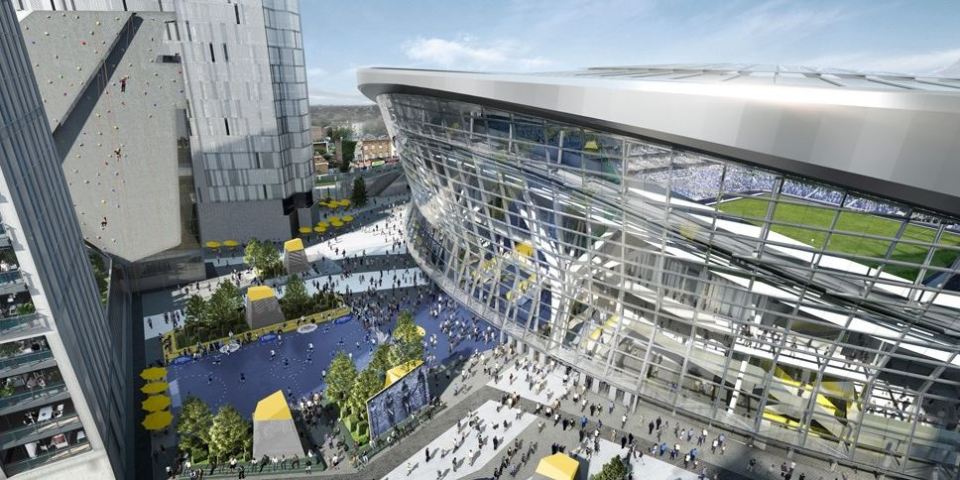 Image: Tottenham Hotspur
 StadiaGaga